Why a Personal Growth Plan Matters
Have you ever felt stuck? Like you want to be better, but you don’t know where to start? You’re not alone. Many people want to grow but feel lost. That’s where a Personal Growth Plan comes in.
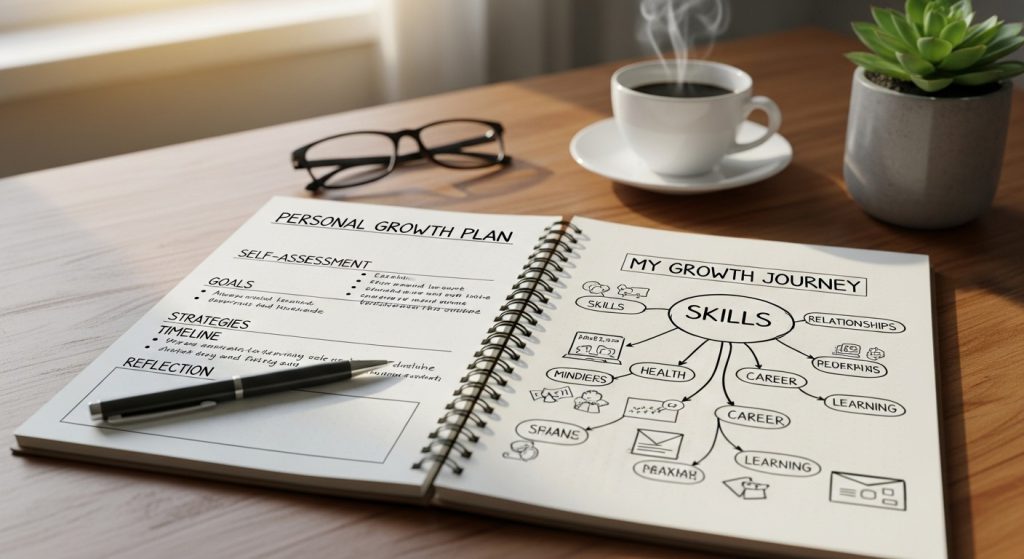
Think of it like a map for your life. Just like you wouldn’t start a road trip without directions, you shouldn’t start your growth journey without a plan. Without a plan, growth feels overwhelming. You might try a little bit of everything and end up nowhere.
Drifting vs. Growing Intentionally:
- Drifting is when life happens to you. You react. You feel lost.
- Growing Intentionally is when you decide where you want to go. You are in the driver’s seat.
This article will give you a simple, step-by-step guide to create your own personal growth plan. You will gain clarity, direction, and the tools to take action. Let’s turn your wish for a better life into a real plan you can follow.
2. What Is a Personal Growth Plan?
2.1 Defining Personal Growth
Personal growth is not about being perfect. It’s about continuous improvement. It’s about becoming a better version of yourself, step by step.
Growth happens in many areas:
- Mental: Learning new things, improving your thinking.
- Emotional: Understanding your feelings, becoming more resilient.
- Spiritual: Finding meaning, purpose, and connection.
- Practical: Building better habits, skills, and a healthier lifestyle.
2.2 Why Planning Accelerates Growth
A plan turns your dreams into a to-do list. It gives you focus and accountability. A study by Dr. Gail Matthews at Dominican University found that people who write down their goals are 42% more likely to achieve them. A plan takes your quiet thoughts and turns them into real-world action.
3. Step 1: Reflect on Where You Are Now
Before you decide where you’re going, you need to know where you are. This step is about honest self-awareness, not self-criticism. Be kind to yourself, just like you would to a good friend.
Ask yourself these reflection questions:
- What is working well in my life right now? (What are my strengths?)
- What areas feel out of alignment or stressful?
- What do I spend most of my time thinking about?
- On a scale of 1-10, how satisfied am I with my health, relationships, work, and inner peace?
This isn’t a test. There are no wrong answers. It’s just information to help you start.
4. Step 2: Clarify Your Values and Vision
Growth is most powerful when it’s guided by purpose, not pressure. What truly matters to you? Your values are your inner compass.
Your values might include: Family, honesty, health, creativity, service, learning, or faith.
Once you know your values, dream a little. What does your best life look like in 3-5 years? Don’t think about limits. Think about what feels meaningful. This vision will guide all your goals.
Outcome: Your growth goals will be aligned with what makes you truly happy, not what you think you should do.
5. Step 3: Set Clear and Realistic Growth Goals
Now, let’s turn that vision into goals. A good goal is like a clear target.
5.1 Short-Term vs. Long-Term Goals
- Long-Term (1-5 years): “I want to be fluent in Spanish.”
- Short-Term (This year/month): “I will complete a beginner Spanish course this year.”
- Right Now (This week): “I will practice Spanish for 20 minutes, three times this week.”
Small, short-term goals are the building blocks of big change.
5.2 Focus on Progress, Not Perfection
Set goals you can actually achieve. It’s better to set a small goal and meet it than a huge goal and give up. Your goals can change as your life changes—that’s okay!
Use the SMART method to make goals clear:
- Specific (Clear and detailed)
- Measurable (You can track it)
- Achievable (It’s realistic)
- Relevant (It matches your values)
- Time-bound (Has a deadline)
6. Step 4: Break Goals Into Actionable Habits
Goals are the destination. Habits are the daily drive to get there. Consistency matters more than intensity. Reading 10 pages a day is better than trying to read a whole book in one night and burning out.
Examples:
- Goal: Improve mental health.
- Habit: Journal for 5 minutes every morning.
- Goal: Grow spiritually.
- Habit: Spend 10 minutes in quiet prayer or meditation daily.
- Goal: Get physically healthier.
- Habit: Take a 15-minute walk after lunch.
7. Step 5: Create a Simple Growth Routine
A routine groups your habits together so they become automatic. Design routines that fit your life, not someone else’s.
A simple morning growth routine could be:
- Drink a glass of water (5:00 AM).
- Read an inspirational book for 10 minutes (5:05 AM).
- Write down 3 things you’re grateful for (5:15 AM).
An evening reflection routine could be:
- Review what went well today (9:00 PM).
- Plan your top 3 tasks for tomorrow (9:05 PM).
- Do a brief mindfulness exercise (9:10 PM).
Keep it flexible. The goal is to support your growth, not to create more stress.
8. Step 6: Track Progress and Reflect Regularly
How do you know if you’re growing? You track it! But measure more than just results. Measure your effort and consistency.
Simple tracking methods:
- Keep a journal.
- Use a simple calendar to check off daily habits.
- Have a weekly 15-minute check-in with yourself.
Reflection helps you learn. If you miss a habit, ask “Why?” without judgment. Use setbacks as feedback to adjust your plan.
9. Step 7: Overcome Common Personal Growth Obstacles
Everyone faces obstacles. Expect them, and have a plan to get past them.
- Lack of Motivation: Motivation fades. Discipline carries you. Go back to your “why”—your vision and values.
- Fear of Failure: Reframe failure as learning. Every misstep teaches you something.
- Inconsistency: Don’t let a bad day ruin a good plan. Just start again the next day. The statistic of “21 days to form a habit” is a myth; research from University College London suggests it takes an average of 66 days for a new behavior to become automatic. Be patient.
- Burnout: If you’re exhausted, your plan might be too aggressive. Rest is part of growth, not the enemy of it.
See obstacles as feedback, not failure.
10. Adapting Your Personal Growth Plan Over Time
Your growth plan is a living document, not a stone tablet. Life changes. Your priorities will, too. It’s healthy and smart to revisit your plan every 3-6 months.
Allow for seasons of rest and seasons of intense growth. It’s all part of the journey.
11. How a Personal Growth Plan Improves Daily Life
When you grow intentionally, your whole life improves. You will likely experience:
- Better Decision-Making: Your choices align with your values.
- Increased Confidence: You prove to yourself that you can keep promises to yourself.
- Stronger Emotional Balance: You understand yourself better and can manage stress.
- Deeper Sense of Purpose: You wake up each day with direction.
12. Frequently Asked Questions
FAQ 1: How long should a personal growth plan be?
It can be one page! The length doesn’t matter. Clarity does. A simple list of values, a vision sentence, 3-5 main goals, and your key habits is a perfect start.
FAQ 2: Can I focus on more than one area at a time?
Yes, but start small. Trying to overhaul your health, career, and relationships all at once is a recipe for burnout. Pick 1-2 key areas to focus on for your first 90 days.
FAQ 3: How often should I update my growth plan?
Do a quick review weekly, a deeper check-in monthly, and a full “revision” every 3-6 months. Update it whenever a big life change happens.
FAQ 4: What if I fail to follow my plan?
You haven’t failed; you’ve collected data. Ask: “Was my plan too ambitious?” “Did an unexpected event happen?” “What one small step can I take today to get back on track?” Then, begin again.
FAQ 5: Do I need tools or apps to create a growth plan?
No. A simple notebook and pen are powerful enough. If you like technology, apps like Notion, Trello, or a basic notes app can be helpful. But the tool is not as important as the thought process.
13. Final Reflection: Growth Is Built One Step at a Time
Personal growth is a lifelong journey, not a quick fix. You don’t have to have it all figured out today. You just need to take the first small, intentional step.
Start where you are. Use what you have. Do what you can. Your future self will thank you for the map you create today.
Your Next Step: Grab a piece of paper right now. Write down one thing you learned from this article that you will do this week. That’s the beginning of your plan.