Why Values Are Shaped, Not Chosen Overnight
Have you ever wondered why you feel strongly about honesty, kindness, or fairness? Or why a friend who went through a tough time now deeply values helping others? Our values—the deep beliefs that guide our choices—aren’t just things we learn from a list. They are shaped by our lives.
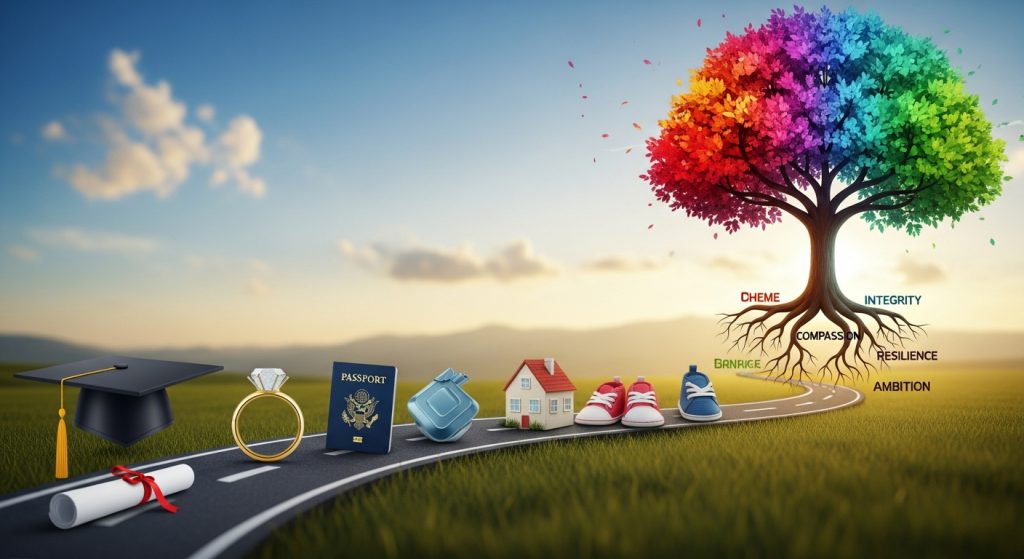
Think of values like a backpack you carry. When you are born, your family starts putting a few things in it—like “be polite” or “work hard.” But as you walk through life, you add your own items based on what happens to you. A scary storm might make you pack a flashlight (value: preparedness). A friend’s kindness when you’re sad might make you pack a bandage (value: compassion).
This article will show you how life experiences shape our values. We will talk about good times, hard times, and everything in between. You will learn how values form, why they change, and how you can understand your own values better.
You will learn:
- What personal values really are.
- How different experiences act like teachers.
- Why reflection is the key to learning from life.
- How to use your own story to live with more purpose.
2. What Are Personal Values?
2.1 Defining Values in Simple Terms
Values are your inner rules for life. They are the things you believe are most important, like a compass that helps you make decisions. Some common values are honesty, family, freedom, safety, kindness, and achievement.
There’s a big difference between learned values and lived values.
- Learned Values: These are what people tell you are important. For example, your parents might say, “Sharing is good.”
- Lived Values: These are what you discover are important through your own experiences. For example, if you share your lunch and it makes a lonely classmate smile, you feel why sharing matters. It becomes your value.
2.2 How Values Show Up in Daily Life
Your values show up in what you do, not just what you say.
- If you value family, you might choose to call your grandma instead of playing video games.
- If you value honesty, you might tell the truth even when it’s hard.
- Your values guide what job you choose, how you treat people, and where you spend your time and money.
3. How Life Experiences Influence Values
Life experiences are like classes we never signed up for. They teach us powerful lessons that stick with us.
3.1 Experiences That Challenge Beliefs
Sometimes, what we think about the world gets turned upside down.
- Example: A child who is taught that “all people are kind” might meet someone who is mean. This experience challenges the old belief. It might teach them the value of caution or discernment.
3.2 Experiences That Create Empathy
Empathy is the ability to understand how someone else feels. We often build this by going through tough feelings ourselves.
- Example: If you’ve ever felt left out, you are more likely to value inclusion and make sure others aren’t left out. Studies show that people who have faced adversity are often more compassionate. One study found that over 70% of people reported that a personal struggle increased their empathy for others.
3.3 Experiences That Clarify Priorities
Big life events—like the birth of a child, a serious illness, or losing someone you love act like a magnifying glass. They show you what really matters.
- Example: After recovering from an illness, a person might stop valuing “busyness” so much and start valuing health and time with loved ones more.
4. Key Types of Life Experiences That Shape Values
4.1 Childhood and Family Environment
This is where our first “value backpack” gets packed. How our family treats us and each other sets the first rules.
- Shapes values like: Security, loyalty, respect (or sometimes, if the environment was hard, it can shape a strong value for peace or independence later in life).
4.2 Hardship and Adversity
Failing a test, losing a job, going through a grief—these painful times are powerful teachers.
- Shapes values like: Resilience (the ability to bounce back), humility, and appreciation for what you have. Research on resilience indicates that successfully navigating hardship can lead to what experts call “post-traumatic growth,” where people develop stronger personal values.
4.3 Relationships and Community
The people we meet are mirrors. They show us who we are and who we want to be.
- A great friend can teach you loyalty.
- A hurtful conflict can teach you forgiveness or boundaries.
- A wise mentor can inspire you to value lifelong learning.
4.4 Success and Achievement
Winning, achieving a goal, or being praised also shapes values.
- Shapes values like: Confidence, ambition, and responsibility. It can also teach humility if you realize you didn’t do it alone. Success teaches us what we’re capable of.
4.5 Spiritual or Reflective Experiences
These are quiet moments that make us think about the big picture in nature, in prayer, or in meditation.
- Shapes values like: Purpose, connection, gratitude, and inner peace. They help us ask, “What is my life for?”
5. The Role of Reflection in Value Formation
An experience alone doesn’t shape a value. Reflection is the magic step in between.
Imagine you trip and fall in front of people. That’s the experience.
- Without reflection: You just feel embarrassed and forget about it.
- With reflection: You think, “My friend helped me up and made me laugh. That made me feel better.” The lesson becomes: Friendship and kindness are powerful. That’s a value.
How to reflect: Talk about it, write in a journal, go for a thoughtful walk. Ask yourself: “What did this teach me? What became important to me because of it?”
6. How Values Change Over Time
Our values aren’t set in stone. They grow and change as we do, much like we outgrow clothes.
- Values in Early Adulthood (20s-30s): Often focus on independence, exploration, achievement, and identity. “Who am I and what can I do?”
- Values in Midlife (40s-50s): Often shift toward balance, meaningful relationships, purpose, and contribution. “What truly matters and who do I care for?”
- Values Later in Life (60s+): Often emphasize legacy, wisdom, community, and peace. “What will I leave behind, and how can I share what I’ve learned?”
7. Positive and Negative Experiences as Teachers
Both good and bad times are teachers.
- Joy & Success teach us about gratitude, hope, and what’s possible.
- Mistakes & Regret are some of life’s best teachers. They powerfully shape values like integrity (“I’ll never do that again”) and forgiveness.
- Discomfort often teaches the deepest values. Trying something new (discomfort) can teach courage. Having a hard conversation (discomfort) can teach honesty.
8. How Life Experiences Shape Moral and Ethical Choices
Our “right and wrong” compass is built through living. When you see someone cheat and get in trouble, you learn about consequences. When you stand up for someone, you feel the power of justice. Leaders who have experienced struggle often value fairness. People who have been helped often value service. Our experiences write the rulebook for our own integrity.
9. Applying Life Lessons to Intentional Value Growth
You don’t have to just wait for experiences to happen. You can use your past to build your future.
- Identify the Lessons: Look back at a key moment in your life. What did it teach you about what’s important?
- Name the Value: Put a word to that lesson (e.g., “That taught me to be brave”).
- Align Your Actions: Make small choices that match that value. If you learned kindness matters, perform one small act of kindness this week.
10. Common Misconceptions About Values and Experience
- Misconception: “Values never change.”
- Truth: Values evolve with you. It’s a sign of growth, not being flaky.
- Misconception: “Hardship only harms people.”
- Truth: While very hard, hardship can also be a powerful teacher of strength and perspective. It depends on reflection and support.
- Misconception: “Success automatically builds good character.”
- Truth: Success tests character. It’s how we handle success—with humility or arrogance—that shapes our values.
The Reframe: Growth depends on awareness, not just circumstance. A mindful person can learn from any experience.
11. Frequently Asked Questions
FAQ 1: Can values really change over time?
Yes, absolutely! Just as you grow and learn, your values can deepen or shift. A teenager might value excitement, but as a parent, they might value safety more. This is normal and healthy.
FAQ 2: Why do difficult experiences shape values more strongly?
Painful experiences often force us to stop and pay attention. They ask big questions: “What do I stand for?” “What really matters?” Because the emotions are strong, the lessons often stick with us more deeply, like carving in stone versus writing in sand.
FAQ 3: Can positive experiences shape values too?
Yes! A wonderful teacher can inspire a lifelong value for learning. A joyful trip in nature can create a deep value for beauty and conservation. Positive experiences show us what to move toward.
FAQ 4: How can I identify the values my experiences have shaped?
Try this: Think of 3-5 of your most important life moments (good or bad). For each, ask: “What did this teach me about life? What became important to me because of this?” The answers are clues to your core values.
FAQ 5: How do values influence long-term decision-making?
Values are your filter for big choices. When choosing a career, someone who values creativity will look for a different path than someone who values security. When choosing a partner, shared values like family or adventure create a strong foundation. They help you choose a path that feels true to you.
12. Final Reflection: Becoming Intentional About Growth
Your life experiences are not just a list of things that happened to you. They are your personal teachers. They have been shaping your values all along your sense of right and wrong, what you love, and what you stand for.
The goal is not to have a “perfect” life of only good experiences. The goal is to become a wise student of your own life. To reflect on your storms and your sunny days, and to understand what they’ve placed in your backpack.
You have the power to look at those items—those values—and choose which ones to carry forward. You can decide to live more intentionally, making choices that match the person your experiences have taught you to be. Start today by asking: “What has my life taught me to value?” The answer is the map to your most authentic self.