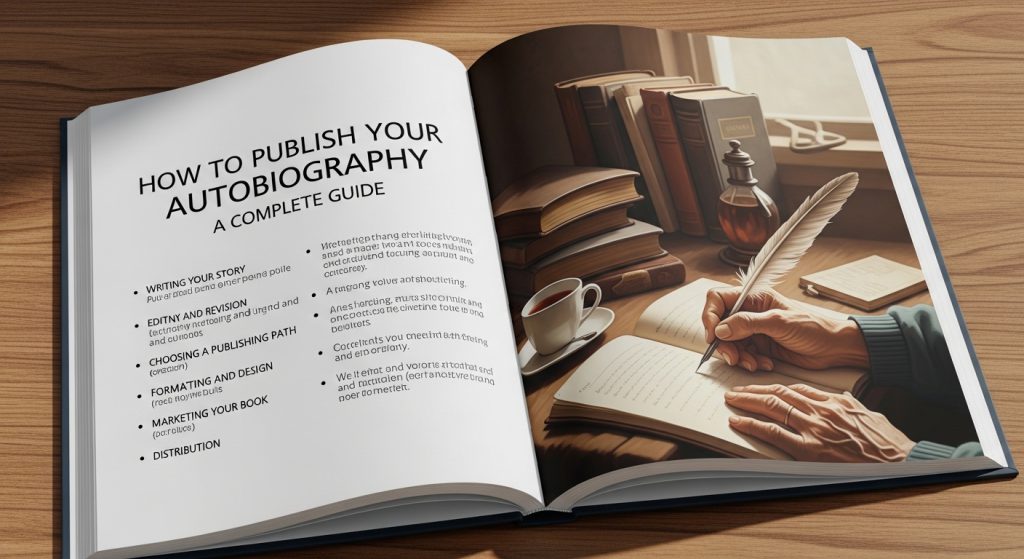
Have you ever held a book and wondered, “Could I do that?” Maybe you have a lifetime of stories stored up lessons learned, adventures had, people loved. The thought of publishing your own autobiography might feel like a dream for “other people,” the famous or the fearless. But here’s the truth: your story matters, and you absolutely can publish it.
This guide is your step-by-step roadmap. We’ll cover everything from the first spark of an idea to holding your finished book. Whether you want to leave a legacy for your family or share your wisdom with the world, you’re in the right place. Let’s turn your memories into a book the world can read.
Part 1: Before You Publish – Laying the Groundwork
Before you even think about book covers or Amazon listings, you need a manuscript. This is the fun, messy, wonderful part where you build the foundation of your book.
Step 1: Remember, Your Story is More Than a List of Events
An autobiography is the story of your life, written by you. It’s a first-person account (using “I” and “me”) that aims to tell your complete story, from childhood to the present. It’s different from a memoir, which often focuses on one specific theme or period.
To get started, don’t just stare at a blank page. Become a detective of your own life.
- Create a timeline: On a big piece of paper, draw a line and mark the big moments: your birth, first day of school, moves, jobs, relationships. This gives you a skeleton.
- Gather your artifacts: Dig out photo albums, old letters, report cards, and souvenirs. These are your “memory triggers.”
- Talk to people: Interview family and old friends. Ask them, “What do you remember about that time?” You might be surprised by what you learn.
Step 2: Find Your Story’s Heart
Your life isn’t just a list of dates. What’s the thread that ties it all together? This is your theme. It could be resilience, the importance of family, the pursuit of a dream, or finding faith. As you look at your timeline, ask yourself, “What’s the story here?” This theme will guide what you include and how you tell it. For a deeper look at crafting your narrative, check out this guide on how to write an autobiography.
Step 3: Write the First Draft (Without the Pressure)
Here’s a secret: you don’t have to write in order. Start with the story that feels most alive to you right now.
- Show, don’t just tell: Instead of “My grandmother was kind,” try “Grandma always had warm chocolate chip cookies waiting. She’d pat the chair and say, ‘Sit, child. Tell me everything.'”
- Use your senses: What did you see, hear, smell, and feel? This puts the reader right in the moment with you.
- Be honest about your feelings: Your emotions are what connect readers to your story. Don’t be afraid to share the struggles and the triumphs. Reading about how others have overcome challenges can be incredibly powerful, as you’ll see in these powerful life lessons from autobiographies.
Your only goal for this draft is to get the story down. Don’t worry about perfection. Just write.
Part 2: Polishing Your Masterpiece
You have a complete draft! Now the real work of transforming it into a professional book begins.
Step 4: Revise and Get Feedback
Put your manuscript away for at least a week. You need fresh eyes.
- Big-picture read: Read it through and look for gaps, confusing parts, or sections that don’t fit your theme.
- Get trusted readers: Ask 2-3 people you trust to read it. Ask them specific questions: Where were you bored? Where did you want more detail? What was your favorite part?
- Hire a professional editor: This is a non-negotiable step for a quality book. An editor does more than fix commas. They help with story flow (developmental edit), sentence structure (line edit), and catching typos (proofreading). Think of them as your personal trainer for your manuscript.
Step 5: Design a Book That Readers Will Judge (and They Will!)
People absolutely judge a book by its cover. You need a professional design.
- Cover design: Hire a professional cover designer. Look at the best autobiographies of all time for inspiration. Your cover should hint at your book’s tone and theme.
- Interior formatting: The inside of your book needs to look professional too with clean fonts, proper margins, and chapter headings. You can hire a formatter or use software like Atticus or Vellum to do it yourself.
Part 3: Publishing Your Book to the World
This is the moment you’ve been working toward. You have two main paths to choose from.
Step 6: Choose Your Publishing Path
| Feature | Traditional Publishing | Self-Publishing |
| Who Does What? | Publisher handles editing, design, printing, and distribution. | You (or people you hire) handle everything. |
| Who Gets Paid? | You get an advance and royalties (a percentage of sales). | You keep all the profits (royalties) after costs. |
| The Hard Part | You need to find a literary agent and a publisher who says “yes.” This can take years. | You pay for editing, cover design, and formatting upfront. You handle all the marketing. |
| Time to Publication | Usually 1-2 years after the deal is signed. | You control the timeline. It can be as fast as a few months. |
Self-publishing is an amazing, powerful option for first-time authors. It puts you in complete control. The main platforms are:
- Amazon Kindle Direct Publishing (KDP): The 800-pound gorilla. Easy to use and gets your book on the world’s biggest bookstore.
- IngramSpark: Gives you access to a wider network of bookstores and libraries.
Step 7: Share Your Story with the World (Marketing)
Publishing your book is only half the battle. Now you need to help readers find it.
- Build your author platform: This is just a fancy way of saying “create a place where people can connect with you.” A simple website and active social media accounts are key.
- Connect with your community: Reach out to local bookstores, libraries, and newspapers. Speak at community groups related to your book’s theme.
- Think about your audience: Who would benefit most from reading your story? Where do they spend their time (online and offline)? Go there and talk to them.
It’s also crucial to understand that your book will sit on shelves alongside books written about people, not just by them. A biography is someone’s life story written by another person. Knowing the difference helps you position your own work.
Frequently Asked Questions (FAQs)
Q: How much does it cost to self-publish an autobiography?
A: You can do it for a few hundred dollars if you’re handy and do the formatting yourself, but for a professional result, budget between $2,000 and $5,000 for a good editor, cover design, and formatting. This is an investment in your book.
Q: How long should my autobiography be?
A: There’s no rule. Most first-time authors end up between 200 and 300 pages. The right length is whatever it takes to tell your story well without padding it.
Q: Do I need to be famous to publish an autobiography?
A: Absolutely not! Some of the most powerful and beloved autobiographies are by “ordinary” people with extraordinary stories of resilience, love, and life. Your family and friends will treasure it, and your story could inspire strangers, too.
Q: How do I protect the privacy of the people I write about?
A: This is a common concern. You can change names, combine several people into one character, or alter identifying details. If you’re very worried about someone’s reaction, consider showing them what you wrote before publishing.
Q: What if I’m not a good writer? Can I still do this?
A: Yes! You have two options. First, you can hire a ghostwriter to help you tell your story in your voice. Second, you can write it yourself and rely heavily on a good developmental editor to help you shape and polish your words. Your story is the important part; the writing can be learned or hired.
Your Story Is Waiting
The journey of a lifetime your lifetime is ready to be shared. It might seem like a long road from here to a published book, but every author starts with the same first step: a decision to begin.
Start today. Open a notebook and write down one memory. Call a relative and ask one question. Your story is a gift that only you can give. The world is waiting to read it.
Ready to take the first step? Share one sentence about your story in the comments below. We’d love to hear what you’re working on