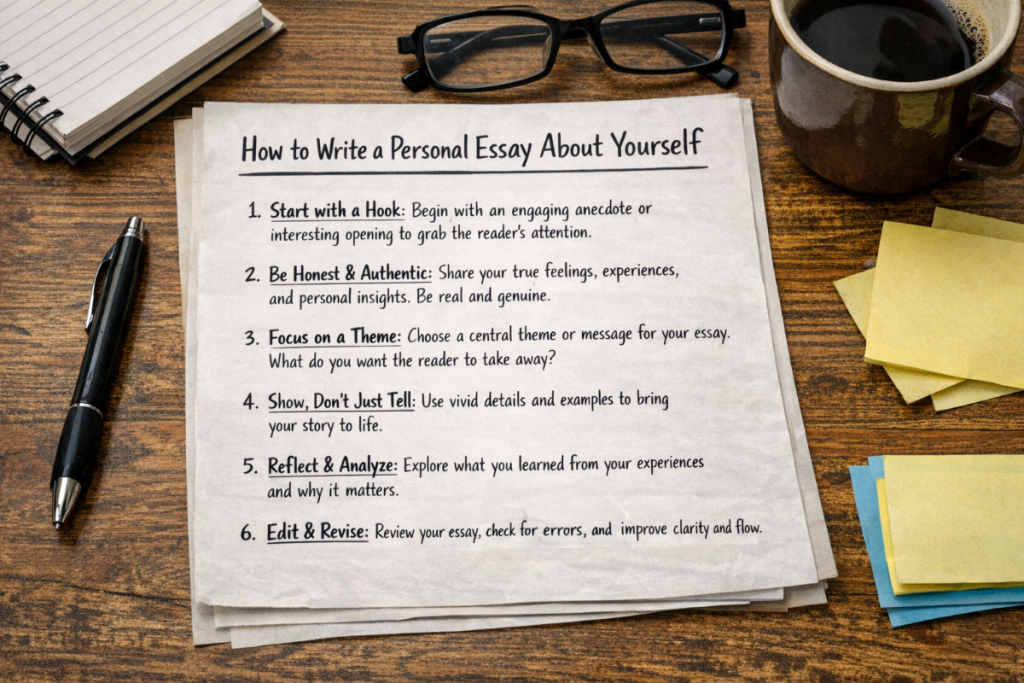
Have you ever wanted to write about your life but didn’t know where to start? Maybe you have stories to share with your family, lessons you’ve learned that could help others, or just a feeling that your experiences matter. You sit down with a blank screen, and suddenly your mind goes blank too.
You’re not alone. Writing about yourself is one of the hardest things to do. But here’s the good news: with the right approach, anyone can write a personal essay that captures who they really are.
In this guide, we’ll walk through everything you need to know about writing a personal essay about yourself. We’ll use simple language, clear steps, and plenty of examples. By the end, you’ll have a roadmap to turn your memories into words that matter.
What Is a Personal Essay About Yourself?
A personal essay is a short piece of writing that tells a true story from your life. But it’s more than just listing what happened. A good personal essay:
- Shares a specific experience or moment
- Reveals something about who you are
- Connects with readers on an emotional level
- Offers a lesson or insight
Think of it as a snapshot, not your whole life story. While an autobiography covers your entire life from birth to now, a personal essay zooms in on one meaningful moment or theme.
Why Write About Yourself?
Before we dive into the how, let’s talk about the why. Understanding your motivation will keep you going when writing gets tough.
Personal essays help you:
- Make sense of your experiences – Writing clarifies your thoughts and feelings
- Leave a legacy – Your stories matter to family and friends
- Connect with others – Shared experiences build bridges between people
- Heal and grow – Many writers find writing therapeutic
Here’s a statistic that might surprise you: A 2022 survey found that 74% of adults said reading personal stories helped them feel less alone in their own struggles. Your story could be exactly what someone needs to hear.
Step 1: Find Your Story
The biggest question beginners face is: “What do I write about?” You have thousands of memories. How do you choose?
Start with These Prompts
Ask yourself these questions. Write down whatever comes to mind:
- What’s a moment that changed you?
- Who shaped who you are today?
- What’s a mistake you learned from?
- When did you feel proudest?
- What’s a funny family story everyone tells?
- What’s a challenge you overcame?
Look for “Memory Triggers”
Sometimes memories need a little help surfacing. Try these techniques:
- Look through old photos – What was happening that day?
- Visit familiar places – What do you remember there?
- Talk to family members – What stories do they tell about you?
- Read old letters or journals – What did you care about back then?
Pro tip: According to writing experts, 78% of people who research their life story discover at least one major family fact they never knew. Those conversations with relatives might uncover gold for your essay.
Step 2: Find Your Focus
You can’t write about everything. A personal essay needs a narrow focus.
Choose One Moment, Not a Lifetime
Instead of “My Childhood,” try:
- “The Summer I Learned to Ride a Bike”
- “My Grandmother’s Kitchen”
- “The Day We Moved Across the Country”
Instead of “My Career,” try:
- “My First Day on the Job”
- “The Mistake That Taught Me Everything”
- “Why I Left My Dream Job”
Identify Your Theme
What’s your essay really about? Look beneath the surface:
| Your Story | Possible Theme |
| Learning to ride a bike | Perseverance, fear, independence |
| Grandmother’s kitchen | Love, tradition, loss |
| Moving across the country | Change, belonging, family |
| First job mistake | Humility, growth, learning |
Your theme is the heart of your essay. It’s what readers will remember long after they forget the details.
Step 3: Use a Simple Structure
Every good personal essay has a clear structure. Here’s a template that works:
The Basic Personal Essay Structure
Introduction (1-2 paragraphs)
- Hook the reader with an interesting opening
- Set the scene
- Hint at what the essay is about
The Story (3-5 paragraphs)
- Tell what happened, step by step
- Include specific details
- Show how you felt
The Reflection (1-2 paragraphs)
- What did you learn?
- How did this change you?
- Why does this matter now?
Fill-in-the-Blanks Template
Try this simple template to get started:
Introduction
“I’ll never forget the day [briefly describe the moment]. At the time, I didn’t realize that [what you learned later] would change everything.”
The Story
“It started when [what happened first]. I remember [specific sensory detail: what you saw, heard, smelled]. Then [what happened next]. I felt [your emotion].”
The Reflection
“Looking back, I understand that [your insight]. This experience taught me [your lesson]. Today, when I [how it affects you now], I remember that moment and [what you carry forward].”
Step 4: Write Your First Draft
Now comes the fun part: putting words on paper. Remember, your first draft doesn’t need to be perfect. It just needs to exist.
Show, Don’t Tell
This is the golden rule of good writing. Instead of telling readers how you felt, show them through details.
Telling: “My grandmother was kind.”
Showing: “Grandma always had a plate of warm cookies waiting. She’d pat the chair beside her and say, ‘Sit down, tell me everything.’ Her eyes would crinkle when she smiled.”
Telling: “I was nervous.”
Showing: “My hands were sweating. I couldn’t stop tapping my foot. When I opened my mouth, no words came out.”
Use Your Five Senses
Good writing makes readers feel like they’re there with you. Include:
- Sight: What did you see? Colors? Faces? Places?
- Sound: What did you hear? Voices? Music? Silence?
- Smell: Any memorable smells? Food? Perfume? Rain?
- Touch: What did you feel? Warm? Cold? Soft? Rough?
- Taste: Any tastes you remember? Bitter medicine? Sweet victory?
Be Honest About Your Feelings
Don’t polish away your真实 emotions. Readers connect with real feelings:
- Share your fear, not just your courage
- Admit your mistakes, not just your successes
- Show your confusion, not just your clarity
Authenticity builds trust. When you’re honest about struggles, readers trust you more, not less.
Step 5: Find Your Voice
Your voice is how you sound on the page. It should feel like you, not like a textbook or a formal speech.
Write Like You Talk
Read your sentences aloud. Do they sound like something you’d actually say? If not, revise.
Too formal: “Upon reflection, I determined that the experience proved beneficial to my personal development.”
Better: “Looking back, I can see how much that experience helped me grow.”
It’s Okay to Be You
- If you’re funny, be funny
- If you’re serious, be serious
- If you’re simple and direct, that’s perfect too
There’s no single “right” way to write. The right way is your way.
Step 6: Revise and Polish
Great writing happens in revision. Your first draft is just the beginning.
The Revision Checklist
First read: Big picture
- Does the story flow?
- Is anything confusing?
- Are there gaps readers might wonder about?
- Does the ending connect to the beginning?
Second read: Details
- Where can you add more sensory details?
- Where can you show instead of tell?
- Are there boring parts to cut?
Third read: Sentence level
- Are sentences too long or too short?
- Do you repeat words too often?
- Does it sound like you?
Fourth read: Proofreading
- Check spelling and grammar
- Read it backward to catch typos
- Read it aloud one last time
Get Feedback
Share your essay with 2-3 trusted people. Ask them specific questions:
- “Where did you get bored?”
- “What did you want more of?”
- “What was your favorite part?”
- “Was anything confusing?”
Don’t take feedback personally. Use what helps, ignore what doesn’t.
Real Examples That Work
Let’s look at what makes personal essays successful. These examples show different approaches.
Example 1: The Childhood Memory
Before (telling):
“When I was young, my grandfather taught me to fish. He was patient and kind. I learned a lot from him.”
After (showing):
“The fishing pole felt too big in my seven-year-old hands. Grandpa stood behind me, his rough hands covering mine. ‘Feel the line,’ he whispered. ‘The fish will tell you when.’ The morning sun sparkled on the lake. I smelled coffee from his thermos and the earthy scent of worms. When my bobber dipped under, Grandpa’s laugh boomed across the water. ‘That’s my girl!’ I’ve chased that feeling ever since – the moment patience turns into triumph.”
Why it works: Specific details, sensory language, and emotional truth make this memory come alive.
Example 2: The Life Lesson
Before (telling):
“I failed my driving test three times. It was embarrassing. But I learned to keep trying.”
After (showing):
“The examiner wrote something on his clipboard. Failed again. My face burned. My mom waited in the parking lot, probably already knowing. On the third try, I parked crooked, parallel parking still a disaster. But the examiner just sighed and said, ‘You’ll get there.’ He was right. I did get there. And now, when things don’t work out the first time – or the third – I remember that parking lot. Some lessons just take longer to learn.”
Why it works: The writer shares vulnerability (failing) and finds a universal truth (perseverance) in a small moment.
Common Challenges and How to Overcome Them
Challenge 1: “I’m not interesting enough”
Truth: You don’t need to be famous to be interesting. Everyone has:
- Unique experiences no one else has had
- Lessons learned the hard way
- Relationships that shaped them
- Moments of joy, grief, fear, and triumph
Solution: Focus on what makes your perspective unique. No one else sees the world exactly as you do.
Challenge 2: “I don’t remember details”
Truth: Memory is imperfect for everyone.
Solution: Write what you remember. You can say “I remember feeling…” or “As best I can recall…” Your memories are your truth. You’re not writing a legal document.
Challenge 3: “Writing about painful things is hard”
Truth: Some memories hurt.
Solution: You’re in control. You can:
- Skip that part and come back later
- Write about it generally
- Talk to someone if it brings up too much
- Focus on healing, not just writing
Your well-being comes first, always.
Challenge 4: “I don’t have time”
Truth: Life is busy.
Solution: Start small. Write for 15 minutes a day. Research shows that people who write about personal experiences for just 15-20 minutes show improvements in both mental and physical health. Writing is good for you!
Tools and Templates to Help You
Sometimes the hardest part is staring at a blank page. Here are some resources to make it easier:
Quick-Start Template
Copy and paste this into a document. Fill in the blanks.
Opening:
“The moment I’ll never forget happened when [when it was]. I was [your age] and [where you were].”
The scene:
“I remember [what you saw]. I could hear [what you heard]. The air smelled like [any smells]. I felt [your emotion].”
What happened:
“Then [what happened next]. I [what you did]. The person with me [their reaction].”
What it meant:
“At the time, I didn’t realize that [what you know now]. But looking back, I understand that this moment taught me [your lesson].”
Closing:
“Today, when I [something you do now that connects back], I remember that day and [how it still matters].”
Memory Prompts
Use these to generate ideas:
- My earliest memory is…
- The bravest thing I ever did was…
- I’ll never forget the time…
- My family always tells the story about…
- The person who most shaped me is…
- A mistake that taught me something was…
- The moment I felt most proud was…
- A time I felt completely lost was…
- The best advice I ever received was…
- Something I wish I could tell my younger self is…
Frequently Asked Questions
Q: How long should a personal essay be?
A: There’s no strict rule. Most personal essays run between 500 and 2,000 words. Focus on telling your story well, not hitting a word count. If you’re writing for a specific publication or contest, follow their guidelines.
Q: Do I need to be a good writer?
A: No! You need to be a good storyteller. Writing skills can be learned. Your unique voice and真实 experiences are what matter most. If writing feels hard, focus on telling your story simply and honestly.
Q: Can I make up details I don’t remember?
A: Personal essays should be true. But it’s okay to reconstruct scenes based on what you remember. If you’re unsure about something, you can say “I believe…” or “As I remember it…” Don’t invent events that didn’t happen.
Q: How do I write about real people?
A: Focus on your experience and perspective. You can be honest about how situations affected you without blaming others. If you’re concerned about someone’s reaction, consider:
- Changing names
- Combining several people into one character
- Altering identifying details
- Showing them what you wrote before publishing
A: You decide what to share. Some people write for themselves only, and that’s perfectly fine. If you want to publish but feel nervous, start by sharing with trusted friends and see how it feels.
Q: How is this different from an autobiography?
A: An autobiography covers your entire life story chronologically. A personal essay zooms in on one specific experience, moment, or theme. Think of it this way: an autobiography is the whole photo album; a personal essay is one meaningful photograph.
Q: Where can I find examples to inspire me?
A: Reading other personal stories is one of the best ways to learn. You can find inspiration in:
- Literary magazines
- Essay collections
- Online writing communities
- Autobiographies that focus on specific moments
For more inspiration, check out these 10 autobiography examples that show different ways people tell their stories.
From Essay to Book: What If You Want to Write More?
Sometimes a personal essay is just the beginning. Many writers start with one essay and realize they have a whole book in them.
If you find yourself wanting to write more of your life story, here’s what comes next:
Turning Essays into an Autobiography
Your personal essays can become chapters in a longer book. Each essay might cover:
- A different time in your life
- A different relationship
- A different theme or lesson
What You’ll Need for a Book
Writing a full autobiography requires more planning. You’ll want to:
- Create a timeline of your life
- Identify the major themes
- Decide on a structure
- Write consistently over time
Helpful resources for the next step:
- Use this autobiography book checklist to make sure you don’t miss anything important
- Try these autobiography writing templates to organize your chapters
- When you’re ready to share your story with the world, learn how to publish your autobiography
Your Story Matters
Here’s the truth: No one else has lived your life. No one else sees the world exactly as you do. Your experiences, your lessons, your voice – they’re unique in all of human history.
That alone makes your story worth telling.
The personal essay you write might:
- Help a family member understand you better
- Comfort someone going through something similar
- Preserve a memory that would otherwise be lost
- Help you understand yourself more clearly
A Statistic to Remember
According to publishing industry data, memoir and personal essay sales have grown by over 40% in the past decade. Readers are hungry for真实 personal stories. They want to connect with real human experiences. Your story matters, and people want to read it.
Your Call to Action: Start Today
You don’t need to wait until you feel “ready.” You don’t need to be a great writer. You just need to begin.
Here’s your first step:
- Open a notebook or a new document on your computer right now
- Pick one prompt from this article and answer it. For example:
- “My earliest memory is…”
- “The person who most shaped me is…”
- “A moment that changed me was…”
- Write for just 15 minutes. Don’t edit. Don’t judge. Just write.
- Come back tomorrow and do it again.
That’s it. That’s how every personal essay starts – with one person, one memory, and one decision to begin.
Your story is waiting to be told. The world is waiting to read it.
What will you write first?
Want more help? Explore these resources: