

Have you ever sat down with a cup of coffee and thought about the story of your life? Maybe you wondered if anyone would want to read it. Or perhaps you felt that quiet pull to leave something behind for your kids or grandkids.
You are not alone.
Millions of people every year sit down to write their life stories. Some do it for fame. Most do it for something much deeper. They want to be understood. They want their experiences to mean something. They want their voice to last beyond their years.
This guide will show you exactly what an autobiography is. You will learn how it differs from other life-writing forms. You will see real examples. And you will get a clear, step-by-step path to write your own.
Let us begin.
Autobiography Definition (Simple Explanation)
An autobiography is a book that a person writes about their own life. The author is the subject. The story comes directly from the person who lived it.
Think of it this way. A biography is someone else telling your story. An autobiography is you telling it yourself.
Key characteristics of an autobiography:
- Written in the first person using “I” and “me”
- Covers the author’s life from birth to the present (or up to a major point)
- Includes real events, dates, people, and places
- Offers the author’s personal thoughts and feelings about those events
- Tells a complete narrative with a beginning, middle, and end
Why autobiographies matter in literature and personal storytelling:
Autobiographies give us a window into lives we could never live ourselves. They let us walk in someone else’s shoes. They show us that our struggles are not ours alone. And they preserve history from the people who actually made it or lived through it.
When you read an autobiography, you are not just getting facts. You are getting truth filtered through the one person who knows it best. That is powerful.
What Makes an Autobiography Unique?
Not every life story is an autobiography. Certain elements make this form stand apart from other types of writing.
Written by the subject (first-person narrative)
This is the biggest feature. The author and the main character are the same person. Every sentence comes from lived experience. You are not guessing what someone felt. You are reading it straight from the source.
Covers a full life or significant timeline
Most autobiographies span many years. They start in childhood and move forward. Some focus on a specific period. But the goal is to show a complete arc of growth and change.
Focus on facts, reflection, and personal truth
An autobiography includes real dates, names, and events. But it also includes something else. It includes how the author felt at the time and how they see those events now. That reflection is what turns a timeline into a story.
Chronological vs thematic structure
Most autobiographies follow time order. They start at the beginning and go to the end. But some writers organize their story by themes. They might group chapters around love, work, loss, or faith. Both approaches work. The right choice depends on what story you want to tell.
Autobiography vs Memoir vs Biography
People often mix these up. But they are not the same. Each serves a different purpose. Each asks something different from the writer. Let us break them down clearly.
What Is a Memoir?
A memoir focuses on specific moments or themes in a person’s life. It does not try to cover everything. Instead, it zooms in on a particular time, relationship, or experience.
Memoirs use an emotional lens and storytelling depth. They care less about exact dates and more about how events shaped the person. If your life were a movie, a memoir would be the trailer for the most important scenes.
What Is a Biography?
A biography is written by someone else. The author researches the subject’s life and writes about it from an outside view.
Biographies are research-based and use an external perspective. The author interviews people, digs through records, and pieces together the story. You get facts and analysis, but not the subject’s inner thoughts unless they shared them in letters or interviews.
Key Differences at a Glance
| Feature | Autobiography | Memoir | Biography |
| Author | The subject | The subject | Another person |
| Scope | Full life or long timeline | Specific theme or period | Full life |
| Tone | Personal, reflective | Emotional, intimate | Objective, researched |
| Perspective | First-person | First-person | Third-person |
| Purpose | Tell complete life story | Explore meaning of experiences | Document facts and impact |
Famous Examples of Autobiographies
Reading examples helps you see what works. These books shaped the genre and showed what a life story can do.
Classic autobiographies:
- The Narrative of the Life of Frederick Douglass by Frederick Douglass. Douglass tells his story of escaping slavery and becoming a leader. It is one of the most powerful American autobiographies ever written.
- The Diary of a Young Girl by Anne Frank. Though technically a diary, this book works as an autobiography. It shows the daily life of a Jewish girl hiding during World War II.
- Confessions by Saint Augustine. Written in the 4th century, this is one of the first autobiographies. Augustine reflects on his youth, his sins, and his path to faith.
Modern autobiographies:
- Becoming by Michelle Obama. The former First Lady shares her journey from the South Side of Chicago to the White House. She blends personal stories with public life.
- Long Walk to Freedom by Nelson Mandela. Mandela tells his story from childhood to his fight against apartheid and his years in prison.
- Born a Crime by Trevor Noah. The comedian writes about growing up in South Africa under apartheid. The book focuses on his relationship with his mother.
Celebrity and historical figures:
- The Autobiography of Malcolm X (as told to Alex Haley). This book tells the story of Malcolm X’s transformation from criminal to civil rights leader.
- I Know Why the Caged Bird Sings by Maya Angelou. This is the first in a series of autobiographies covering Angelou’s childhood and young adulthood.
- Open by Andre Agassi. The tennis star offers a brutally honest look at his career, his struggles, and his identity.
Common Themes Found in Autobiographies
Most autobiographies revolve around a few core themes. If you are writing your own, think about which themes show up in your life.
Overcoming adversity
Stories of struggle resonate with readers. They show that hard times can lead to growth. Authors write about poverty, illness, discrimination, abuse, or loss. The story is not just about what happened. It is about how they survived and what they learned.
Personal growth and transformation
People love stories of change. Maybe you went from shy to confident. Maybe you changed careers or found a new purpose. Transformation stories give readers hope that they can change too.
Faith, identity, and purpose
Many autobiographies explore deep questions. Who am I? Why am I here? What do I believe? These books help readers think about their own beliefs and values.
Career journeys and life milestones
Some autobiographies focus on a person’s work life. A musician writes about their first tour. A CEO writes about building a company. These stories often include key moments like marriage, children, or major achievements.
Why People Write Autobiographies
You might wonder why someone would spend months or years writing about their own life. The reasons go far beyond money or fame.
Preserve legacy and life story
Your life matters. Writing it down means it will not be forgotten. Future generations can read your words and know who you were. They can learn from your experiences and carry your story forward.
Share lessons and experiences
You have learned things that others have not. Maybe you learned how to raise a child with special needs. Maybe you learned how to start a business with no money. Those lessons can help others. An autobiography lets you share them widely.
Inspire others
Stories have power. When people read about someone who overcame great odds, they feel braver about their own challenges. Your story could be the push someone needs to keep going.
Personal reflection and healing
Writing forces you to look at your life honestly. You see patterns you missed before. You understand yourself better. Many authors say the writing process itself was healing. It helped them make sense of hard times and find meaning in their struggles.
Types of Autobiographies You Should Know
Not all autobiographies look the same. Some cover everything. Others focus on one area. Knowing the types helps you choose what to write.
Full-Life Autobiography
This is the classic form. It starts with birth or early childhood and moves forward in time. It covers the major events and people that shaped the author. These books can be long. But they give readers a complete picture of a life.
Intellectual or Spiritual Autobiography
This type focuses on the author’s mind or soul. It traces how their thinking changed over time. Or it follows their spiritual journey. Readers learn how the author came to their beliefs and ideas.
Professional or Career Autobiography
These books focus on work life. They cover how the author entered their field, the challenges they faced, and the achievements they earned. Business leaders, artists, and athletes often write these.
Confessional or Personal Journey
These autobiographies go deep into emotional territory. The author shares private struggles like addiction, mental health, or relationship problems. They are honest about mistakes and failures. These books often help readers facing similar struggles.
Basic Structure of an Autobiography
A good structure keeps readers engaged. It also makes writing easier. You always know what comes next.
Introduction (Who You Are)
Start by introducing yourself. Give readers a reason to care about your story. You might share a moment that defines who you are. Or you might explain why you decided to write your life story. Keep this section focused and compelling.
Early Life and Background
Take readers back to where it all began. Write about your family, your childhood home, and your early years. What shaped you as a child? What do you remember most clearly?
Key Life Events and Turning Points
These are the moments that changed everything. A move to a new city. A chance meeting. A sudden loss. A big success. List the turning points in your life and give each one its space.
Challenges and Lessons Learned
Readers want to know what you learned from hard times. Do not just list problems. Show how you handled them and what you took away. This is where your story offers value to others.
Present Life and Reflection
Bring readers up to today. Where are you now? How did your past lead you here? What do you think about when you look back? This section connects the beginning to the end.
Conclusion (Legacy or Message)
End with your final thoughts. What do you want readers to remember? What message do you hope they take with them? Leave them with something meaningful.
How to Start Writing Your Autobiography (Step-by-Step Guide)
Writing your life story can feel overwhelming. But you do not have to do it all at once. Follow these steps to make the process manageable.
Step 1: Define Your Purpose
Ask yourself why you are writing. Are you writing for family? For the public? For yourself? Your purpose shapes everything. It decides what you include, how honest you are, and how much time you spend.
Step 2: Identify Your Audience
Think about who will read your book. If you are writing for your grandchildren, you will focus on family stories. If you are writing for the public, you will think about what readers want to learn. Your audience helps you make choices.
Step 3: Create a Timeline of Your Life
Get a notebook or open a document. Write down the major events of your life in order. Start with your birth and move forward. Include moves, schools, jobs, relationships, and big moments. This timeline becomes your roadmap.
Step 4: Choose a Central Theme
A theme ties your story together. It is the thread that runs through your life. Maybe your theme is resilience. Maybe it is creativity. Maybe it is finding home. Choose one or two themes to guide your writing.
Step 5: Start with a Strong Opening
Your first page decides whether people keep reading. Start with a moment that grabs attention. It could be a dramatic event. It could be a quiet moment that changed everything. Or it could be a question that makes readers curious.
Step 6: Write Honestly and Clearly
Do not try to sound fancy. Write like you talk. Use short sentences. Tell the truth, even when it is hard. Readers can tell when you are holding back. Honesty builds trust and connection.
Step 7: Edit and Refine Your Story
Your first draft will not be perfect. That is normal. Set it aside for a few weeks. Then read it with fresh eyes. Cut what does not fit. Add details where things feel thin. Ask someone you trust to read it and give feedback.
Tips for Writing a Powerful Autobiography
These tips will help your writing stand out and connect with readers.
Be authentic and truthful
Do not pretend to be someone you are not. Do not hide your flaws. Readers want the real you. They want to see your struggles and your growth. Authenticity is what makes a life story powerful.
Show, don’t just tell
Instead of saying “I was scared,” describe what scared you. Instead of saying “My mother was kind,” tell a story that shows her kindness. Showing brings readers into your world.
Use vivid details and memories
Details make stories come alive. What did your grandmother’s kitchen smell like? What sound did your father’s car make? What did your first job feel like? Small details create big impact.
Keep a consistent voice
Your voice is how you sound on the page. Some people write formally. Some write casually. Some use humor. Whatever your voice, keep it steady. Readers should feel like the same person is talking the whole time.
Balance facts with emotion
Facts give readers information. Emotion gives them connection. Do one without the other and your story falls flat. Mix dates and events with how you felt and what you learned.
Common Mistakes to Avoid
Avoid these pitfalls to keep your autobiography strong.
Being too vague or too detailed
Vague writing leaves readers confused. Too many details make them bored. Find the middle ground. Give enough detail to paint a picture, but not so much that readers skim.
Lack of structure
A life story without structure feels like a list. Readers need a sense of direction. Use your timeline and theme to create a clear path from start to finish.
Over-editing your voice
It is good to edit. But do not edit out your personality. If you are funny, let the humor stay. If you are serious, let that come through. Your voice is what makes your story yours.
Ignoring your audience
Writing only for yourself is fine if you never share it. But if you want others to read, think about what they need. Give them context. Explain things they might not know. Help them understand your world.
Skipping emotional depth
Facts alone do not make a story. Readers want to know how events affected you. Do not just say you got divorced. Say how it felt. Say what you learned. Emotional depth is what makes a story meaningful.
Autobiography vs Personal Essay
Some writers confuse autobiographies with personal essays. They are different forms with different purposes.
Length and scope differences
An autobiography is book-length. It covers many years and many events. A personal essay is short. It usually focuses on one moment, one idea, or one theme.
Purpose and tone
An autobiography aims to tell a complete life story. It includes facts, reflection, and narrative arc. A personal essay aims to explore a single idea or experience. It is often more focused on meaning than on facts.
When to choose each format
Choose an autobiography if you want to tell your full story. Choose a personal essay if you want to explore one specific experience or idea. Some writers start with essays and later expand them into a full autobiography.
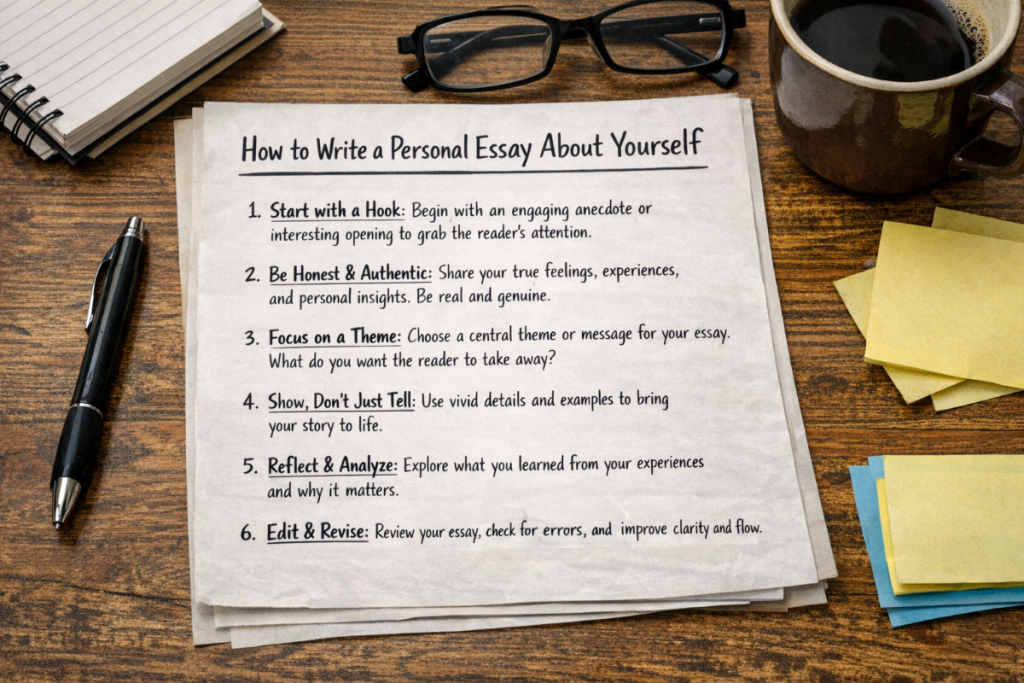
If you are interested in the shorter form, check out this guide on how to write a personal essay about yourself. It walks you through the process step by step.
Quick Autobiography Example (Short Sample)
Here is a short sample to show how an autobiography might sound. This is written in first person with a clear voice and structure.
I was born on a Tuesday in August, three weeks early. My mother always said I was in a hurry to get here. Maybe that is why I have spent my whole life rushing toward the next thing.
My childhood home sat at the end of a gravel road in rural Ohio. Our house was small. The walls were thin. But my mother filled that house with books. Every Saturday morning, we walked to the library. I would come home with a stack of novels so tall I could barely see over it. Those stories showed me a world beyond our town. They made me believe I could build a life outside the cornfields.
When I was fourteen, my father left. I remember standing at the window watching his truck disappear down the road. My mother did not cry. She just stood beside me and put her hand on my shoulder. That moment taught me something I have never forgotten. People leave. But the ones who stay are the ones who matter.
I did leave. I went to college four hundred miles away. I studied journalism because I wanted to tell stories like the ones I read as a child. I became a reporter for a small newspaper. Then a bigger one. Then I started writing books. Each step felt impossible until I took it.
Now I am sixty-three. My hair is gray. My hands ache when the weather changes. I live in a house with a garden and a front porch where I drink coffee every morning. My mother is gone now. But I still think about her at the library, handing me another stack of books, telling me to read them all.
I write this for my grandchildren. I want them to know where they came from. I want them to know that a girl from a gravel road in Ohio can build a life of meaning. And I want them to know that stories matter. They always have.
This sample shows how a writer can use voice, details, and reflection to tell a life story in a compelling way.
Frequently Asked Questions (FAQs)
What is the main purpose of an autobiography?
The main purpose is to tell your life story from your own point of view. You share your experiences, your thoughts, and your growth. Some people write to preserve their legacy. Others write to share lessons or inspire readers. The purpose shapes how you write and who you write for.
How long should an autobiography be?
There is no set length. A full autobiography often runs between 50,000 and 100,000 words. But some are shorter. Some are longer. The right length depends on your story and your audience. Focus on telling your story well. The length will work itself out.
Can anyone write an autobiography?
Yes. You do not need to be famous. You do not need to have done extraordinary things. Every life has a story. Your experiences matter. Your voice matters. Anyone with a story to tell can write an autobiography.
Is an autobiography always true?
An autobiography should be truthful to the best of the author’s memory. But memory is not perfect. Two people can remember the same event differently. Readers expect honesty, not perfection. If you are unsure about a detail, say so. Your truth is what matters.
What is the difference between autobiography and memoir?
An autobiography covers a full life or a long timeline. It moves chronologically and includes many events. A memoir focuses on a specific theme or period. It goes deep on one part of life rather than trying to cover everything. For a deeper look at life writing, explore this collection of mental health autobiographies to see different approaches.
Final Thoughts: Why Your Story Matters
Your life is one of a kind. No one else has walked your path. No one else has seen what you have seen or learned what you have learned.
That matters.
Your story can help someone who feels alone. It can teach someone who is struggling. It can remind your family who you were and what you stood for. It can live on long after you are gone.
Writing an autobiography takes time. It takes courage. It means looking at your life honestly and putting it on paper for others to see. But the result is worth it.
You are the only person who can tell your story. No one else can give it the voice, the details, and the truth that you can.
So start. Open a notebook. Open a document. Write one memory today. Then write another tomorrow. Bit by bit, your story will come together.
Call to Action (Conversion Section)
Your story deserves to be told. Do not wait for the perfect time. The perfect time is now.
Start writing your autobiography today. Use the steps in this guide to build your timeline, find your theme, and write your first pages.
If you want more help with life writing, check out these resources:
- Mental health autobiographies guide Read examples of powerful life stories
- How to write a personal essay about yourself Learn to craft shorter life stories
Save this article for when you need a refresher. Share it with someone who has a story to tell. And take the first step toward writing your life story today.